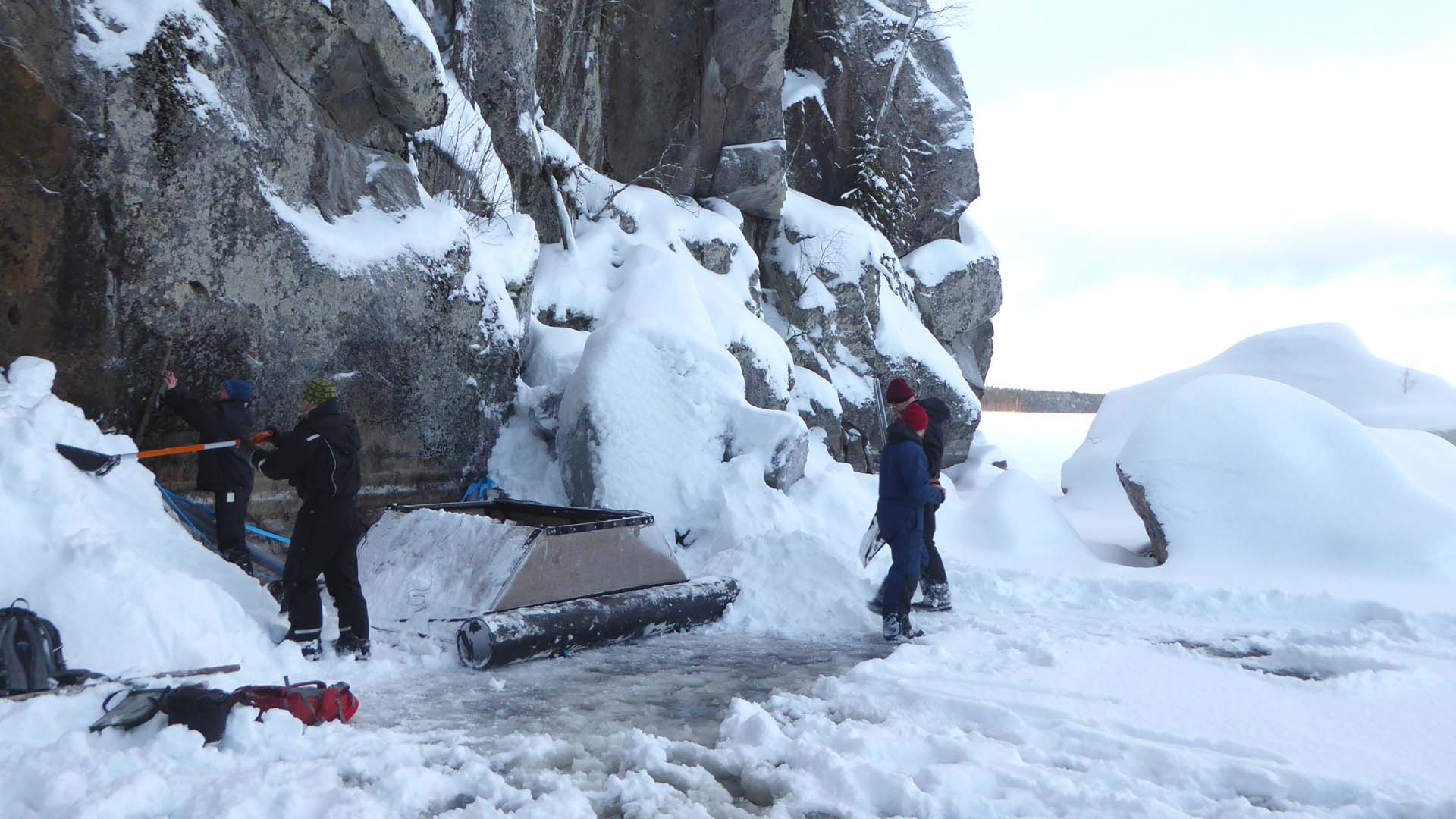
Artificial nests for Saimaa ringed seals are innovation for nature: “The best feedback is a seal thriving in the nest”
Photo: Arvi Tyni
Climate change threatens Saimaa ringed seal breeding. Elomatic has developed artificial nests together with Metsähallitus, the University of Eastern Finland, and Saimaa Group, enabling seals to breed even during increasingly snow-free winters.
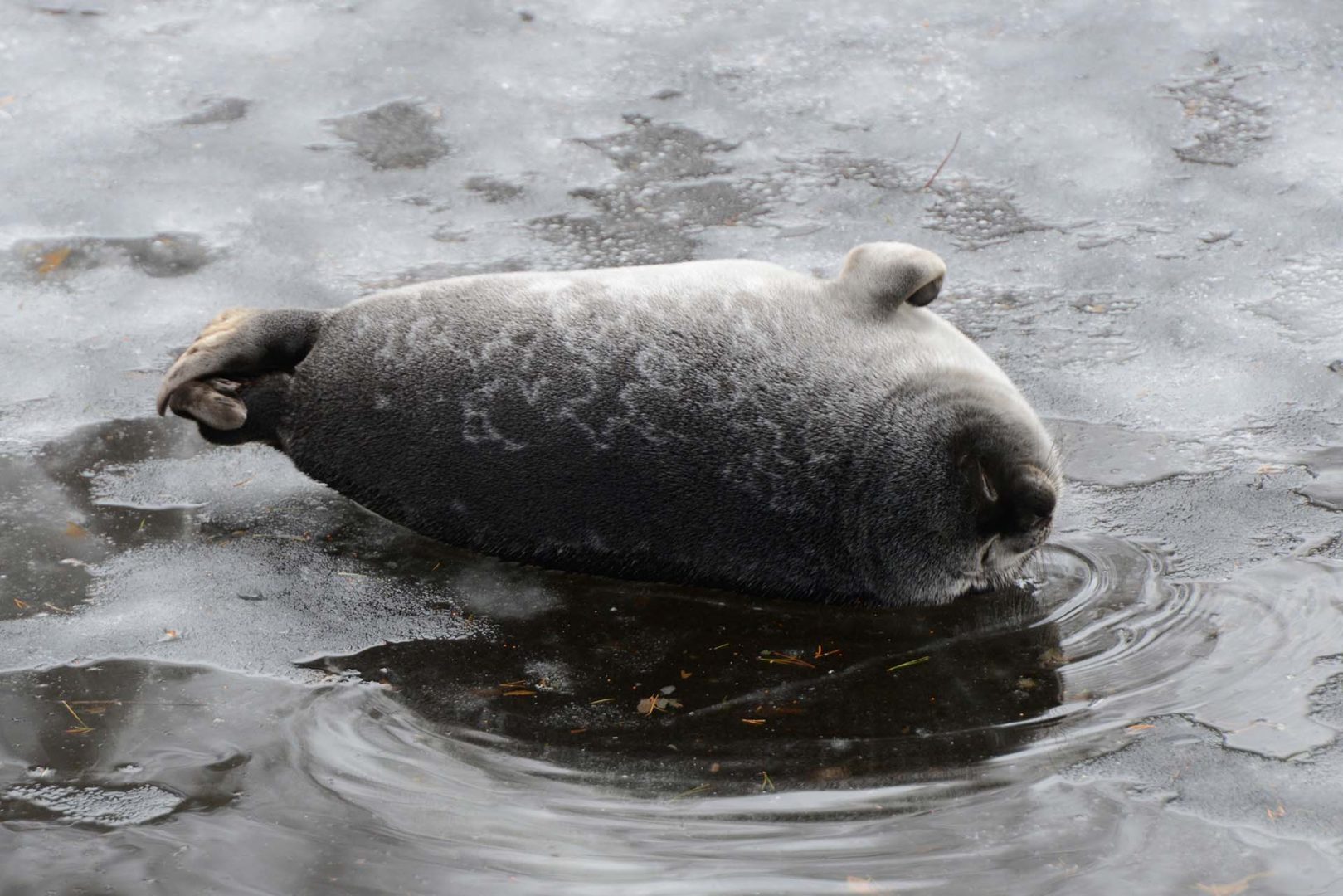
It all started in 2016 with a yellow Post-it note that appeared on the wall of the shared office of Elomatic’s Industrial Designer Jukka Mikkonen and Innovation Specialist Pekka Koivukunnas. The note briefly described an idea for a fiberglass dome in which Saimaa ringed seals could nest during snow-free winters.
The note was written by Sebastian Kankkonen, a Leading Consultant at Elomatic. Before writing the note, he had heard on television news that warming winters caused by climate change were making it harder for Saimaa ringed seals to breed. This prompted Kankkonen to consider what could be done to secure seal breeding.
“I was confident that when I told my idea about developing artificial nests to innovators like Jukka and Pekka, they would get excited and find a solution,” Kankkonen says.
He knew that Mikkonen and Koivukunnas were nature-loving environmentalists like himself, concerned about climate change. Kankkonen also credits Henrik Bächer, Elomatic’s then maritime business director, with initiating the project.
“He gave us permission to use some work time on the project before I managed to secure funding.”
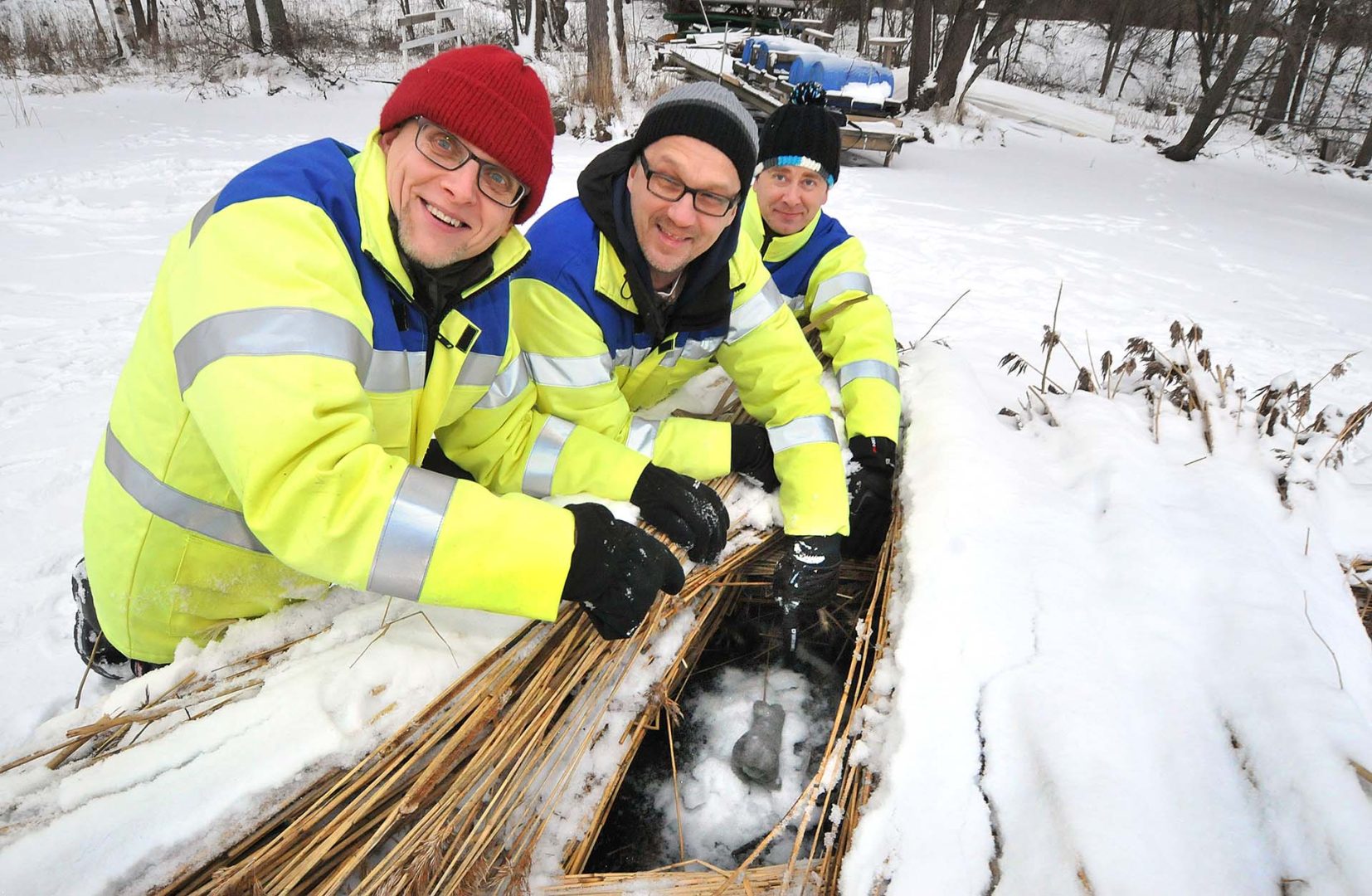
In the picture: artificial nest developers Pekka Koivukunnas, Jukka Mikkonen and Sebastian Kankkonen. Photo: Sauvo Jylhä.
Ten years, seven artificial nest models
Originally, the development of artificial nests began at the University of Eastern Finland in the 2010s. The first floating artificial nest, designed by Taneli Poranen, was installed in Lake Haukivesi in 2016.
Now, ten years later, Mikkonen and the already retired Koivukunnas have designed seven different artificial nest models – dome-like structures – together with Metsähallitus and the University of Eastern Finland.
The collaboration began when the Elomatic trio presented their developed idea of a reed nest to Metsähallitus. Elomatic’s idea was enthusiastically received.
The first artificial nest developed by Elomatic, made of lake reeds and placed on ice, was installed in Lake Haukivesi in 2017, and already that spring, a pup named Kuhilas was born in one of the nests.
Kankkonen, Mikkonen, and Koivukunnas have brought professionalism and systematicity to artificial nest design. As development progressed, it became clear, for example, that nests must be floating, and that artificial nests built solely from natural materials do not adequately protect seals from weather and predators.
The pup named Kuhilas was born in a reed nest in 2017. Photo: Juha Taskinen.
Artificial nest development requires testing
Artificial nests offer the endangered Saimaa ringed seal a safe breeding place. The design process has taken inspiration from the natural nests seals create in snow drifts on ice. This allows seals to be offered conditions that are as authentic as possible for breeding.
The nest has three key elements: a floating structure and protective dome, as well as fastening ropes to secure the nest to rocks, stones, or trees. Over ten years, all elements have been developed step by step, Mikkonen explains.
The nest design has been a long-term product development project. Alongside design, it has been important to build physical models and prototypes of structures, materials, and complete nests. Through these, solutions’ functionality has been tested in practice and feedback obtained for subsequent design and nest implementation stages. For example, various materials have been tested for the dome, from willow to plywood, to trailer hood, to protective tarp, and aluminum.
“Particularly challenging has been developing the fastening ropes to be as fit-for-purpose as possible. It took many years before we succeeded in developing ropes we were satisfied with,” Koivukunnas says.
The result was adjustable, elastic telescopic ropes that withstand variable wind, ice, and water conditions. The design also had to account for the ropes not clattering, as noise could disturb a nesting seal.
Additionally, artificial nest development must consider the nest’s buoyancy, manageability, and portability. The nest must, for example, be light enough for people to move it by hand.
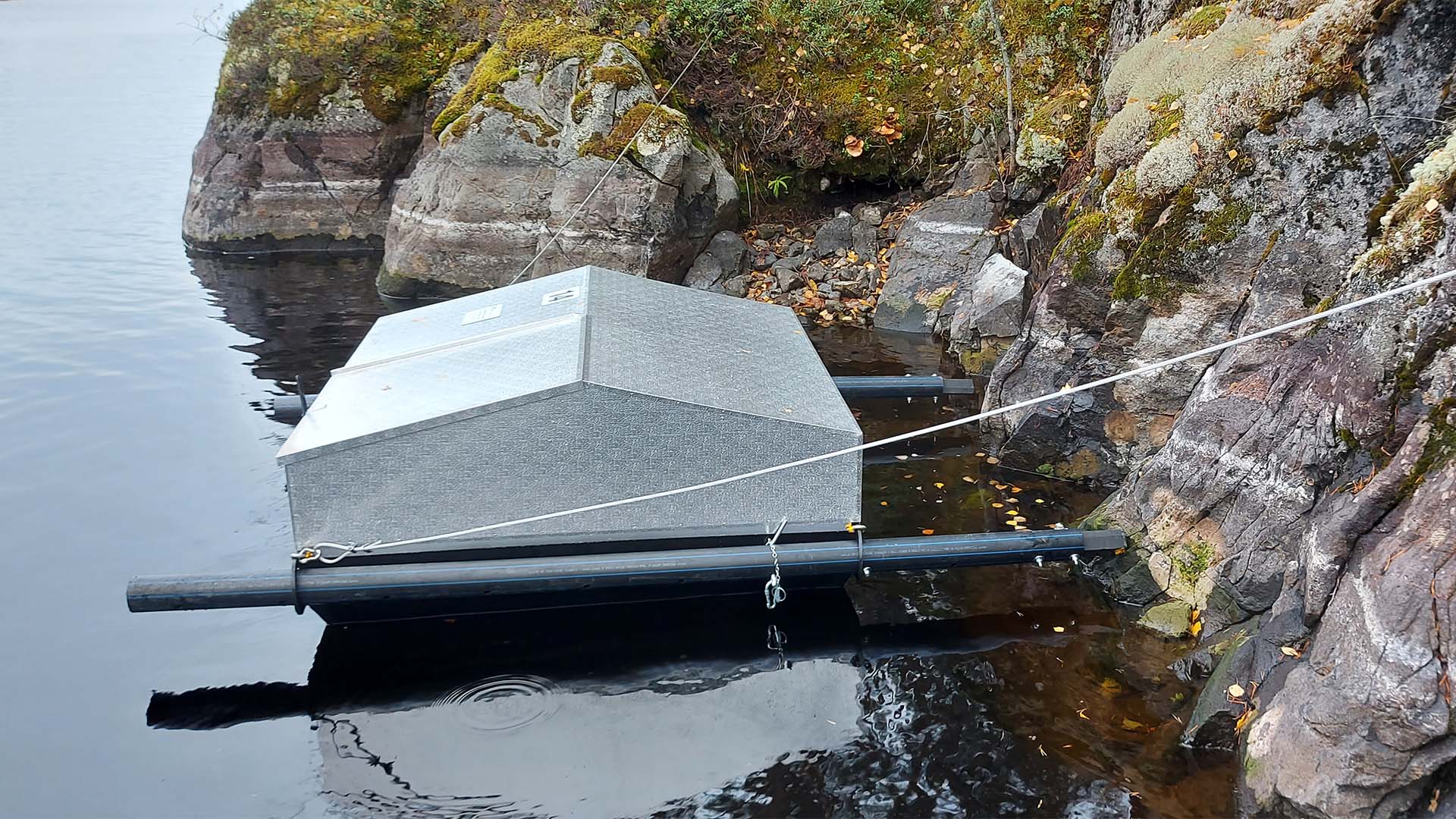
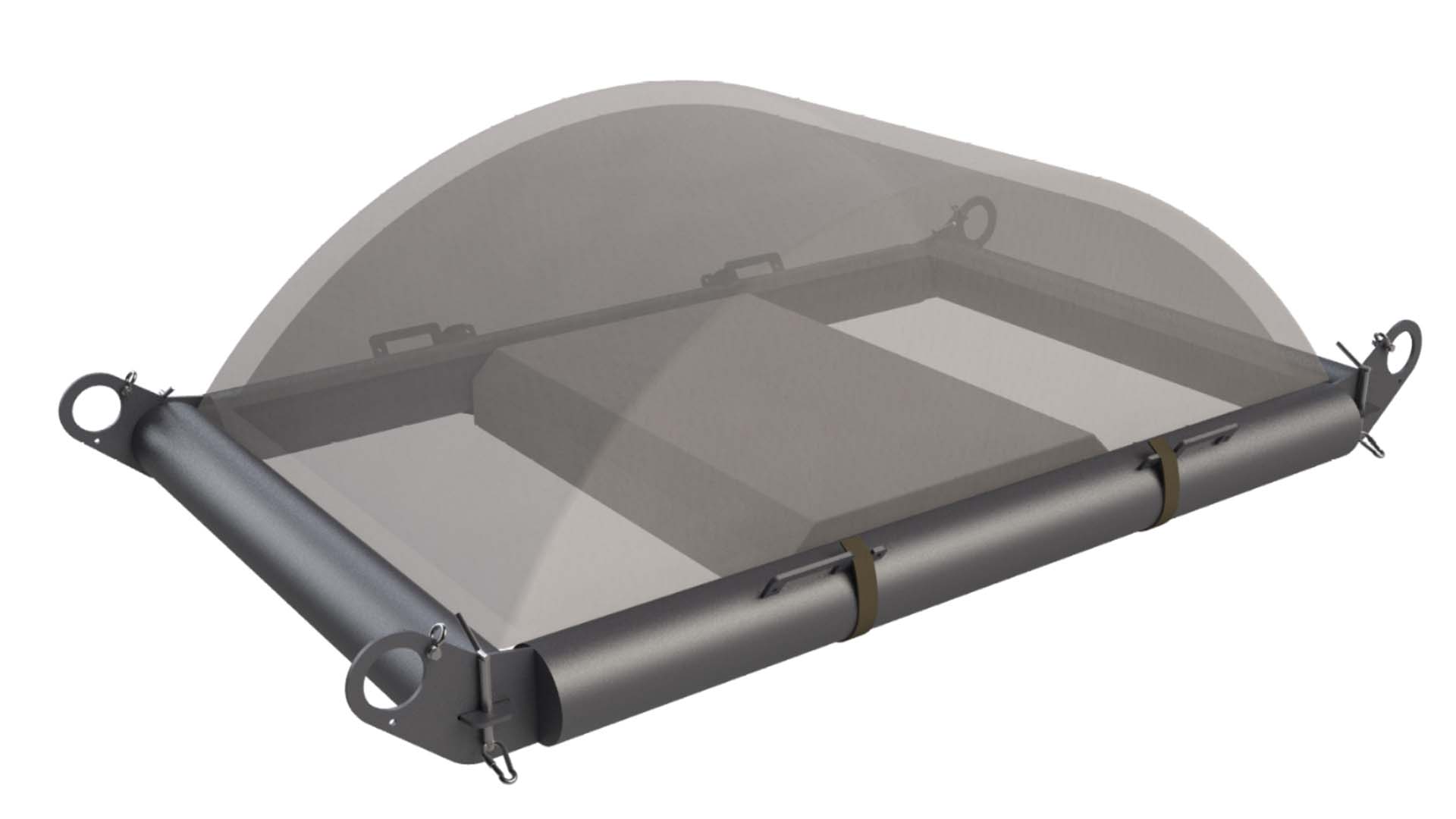
Artificial nests Donitsi and JP, named after its developers Jukka Mikkonen and Pekka Koivukunnas. First photo: Miina Auttila.
Collaboration delivers results
Over the years, Mikkonen and Koivukunnas have innovated, ideated, designed, built prototypes, and conducted various fieldwork, such as nest installation and storage. The project team has included professionals from various fields.
“From the seal researchers in our team at the University of Eastern Finland and Metsähallitus, we have gained valuable knowledge about seal behavior and breeding sites,” Koivukunnas says.
The design had to account for, for example, the fact that the artificial nest must be dark, as light disturbs a nesting seal. Seal researchers were also involved in designing the nest models.
” At one point, a basket weaver participated in the project and wove a protective dome from willow for one of the nest models,” Mikkonen explains.
The project has received funding from, among others, the EU and the Our Saimaa ringed seal LIFE project, as well as modest funding from Metsähallitus and the University of Eastern Finland. In 2022, Saimaa Group joined as a funder and now manufactures the nests. Metsähallitus is responsible for nest installation and maintenance.
Donut nest and JP-nest, designed by Elomatic, in use
Two nest models are now in use. One is the donut nest, designed by Mikkonen and Koivukunnas together with Saimaa Group. It was introduced in 2021.
The donut nest gets its name from the hole in the middle of its welded polyethylene floating structure, through which the seal climbs up a ramp into the nest. The nest’s sleeping area and walls are lined with soft and durable felt, which gives the seal traction with its claws when climbing into the nest. The aluminum dome of the donut nest was designed and built by Saimaa Group.
The second nest model in use is called the JP-nest, named after its developers, Jukka Mikkonen and Pekka Koivukunnas. The JP-nest was introduced in 2022. In the center of its floating frame is a sleeping platform, which the seal reaches by digging through the ice next to the sleeping platform.
The JP-nest works largely on the same principle as the original Taneli-nest designed by Poranen, but in the JP-nest the technical implementation and materials are designed with manufacturing and long-term use in mind.
“The seal notices a darker spot in the ice and digs itself through the ice into the nest using its strong front paw claws. That’s how it works in nature too, when nesting in snow drifts,” Mikkonen explains.
The project has become so important to Mikkonen and Koivukunnas that they have done part of the development work in their own time as volunteer work. The pair have built prototypes on weekends in Koivukunnas’s garage. They continue to actively participate in artificial nest installations and maintenance.
The artificial nests are moved to nesting sites every year. Securing the breeding of the Saimaa ringed seal requires a great deal of human effort: maintaining and relocating the artificial nests and shoveling supplementary snow mounds.
Goal of one hundred artificial nests
Research provides increasingly detailed information on how the nests work. Based on that information, nests are continuously improved – although ideally artificial nests wouldn’t be needed at all, Mikkonen notes.
However, he, Koivukunnas, and Kankkonen, as well as researchers, do not believe this will happen. Forecasts suggest that due to climate change, winters will be even milder in the future.
This spring, a total of 47 artificial nests were installed in the areas of Lake Haukivesi, Pihlajavesi, Suur-Saimaa, Luonteri, and Joutenvesi. Saimaa Group has donated 100 artificial nests, some of which are already in use and some will be completed later. The goal is to have one hundred nests in the area in the coming years.
The nest builders know they have succeeded when the seal accepts the nest.
“Since our target audience is the seal, we naturally do not receive direct feedback on the solutions we have made. Therefore, the best feedback is a seal thriving and breeding in the nest,” Mikkonen says.
An estimated 15 pups have been born in artificial nests so far, but this number will increase in the future. Winters will continue to warm, and if there is not enough snow and lakes do not freeze, seals cannot be helped by snow drifts that facilitate breeding. Then the need for artificial nests is acute.
In the first episode of Engineering Pulse, Elomatic’s Karoliina Joensuu sits down with Antti Arasto, Vice President at VTT, to talk about what makes innovation actually happen inside organizations. They explore the role of trust, the value of failure, and why informal moments often matter more than formal processes.
Tero-Seppo Tuomela, Senior Vice President at Elomatic, has spent over two decades at the company. Today, his primary focus is making innovation happen systematically, not by chance. In a time of compounding disruptions, he sees systematic innovation management more urgent than ever.
We have offices and representatives in Europe, Asia and the Americas. Our main offices are located in Finland and The Netherlands. Contact details of all our offices and representatives can be foundhere.