
Cranes, lifting and transportation equipment
We analyze lifting equipment to ensure safety, reliability, and cost-efficiency.
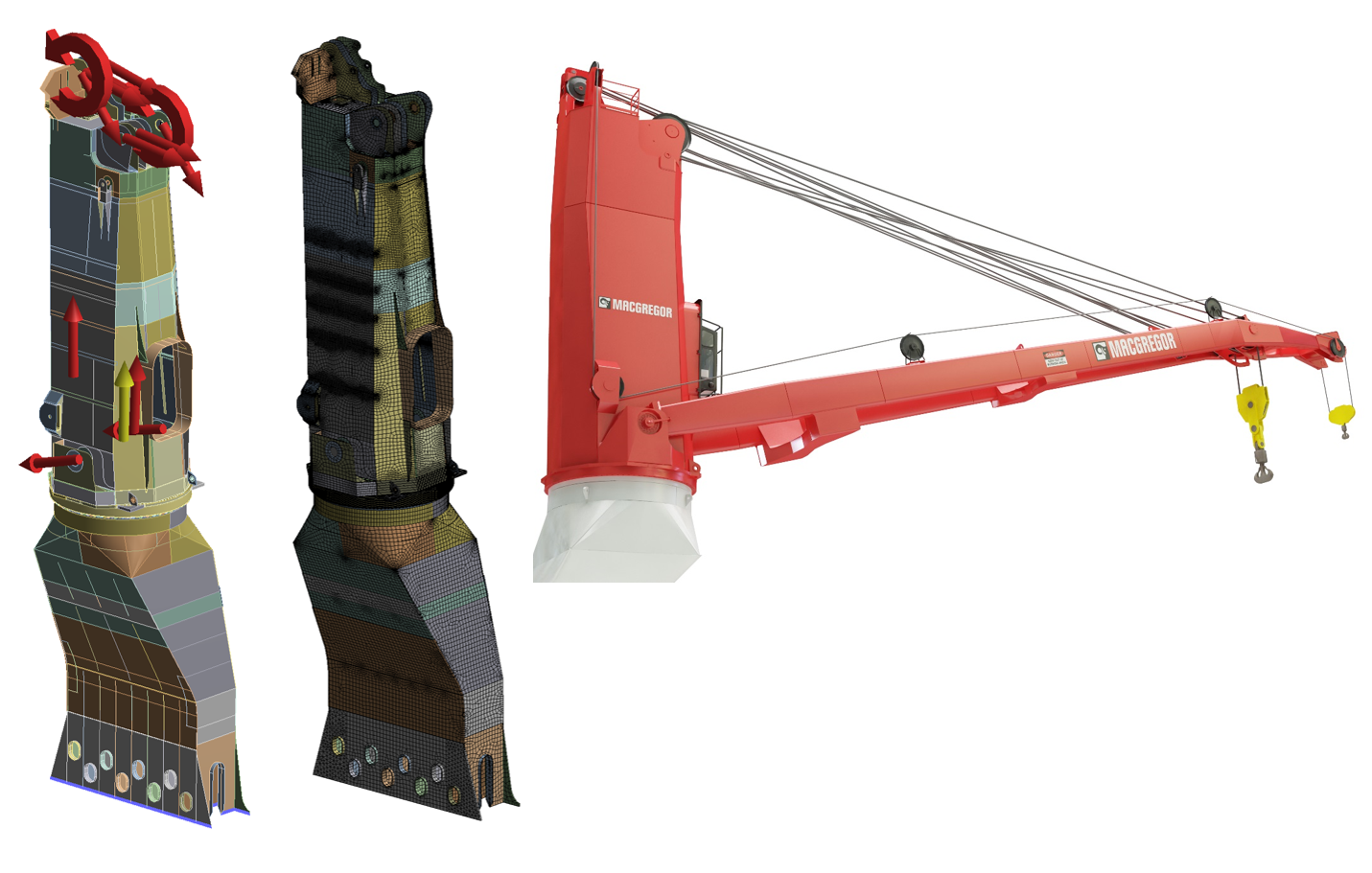
Since 1976, we’ve analyzed shipyard and container cranes, and since 1997, specialized grab cranes. Our expertise spans all crane types – mobile, overhead, port, and offshore – ensuring structural reliability while optimizing for weight, reach, and cost.
Early-stage analysis accelerates concept evaluation and refinement. We validate new designs through FE analysis, troubleshoot field issues, and recommend improvements for existing equipment. Our deep understanding of classification requirements ensures smooth certification to DNV, EN, and other international standards.
We ensure safe handling, lifts and transport of your products at all stages from production to commissioning on the other side of the globe. All lifts and transportation steps during production, assembly, commissioning and service need to be safe and cause no damage to the product.
Our structural analysis provides services to dimension lifting aids, lashing points and the forces applied to them, ensure the durability of sensitive equipment in handling situations, and design the necessary handling supports, packaging that protects the product, and transport frames from the beginning to the end of the product handling chain.
Services and expertise
- DNV and Norsok
- EN 13001 and EN 15011
- CMAA 70 and 74
- EN 280 (Mobile elevating work platforms)
- EN14492
Contact us

Do you want to know more?
Simulation-based R&D
Simulation helps us identify potential problems at an early stage, accelerate the development process, reduce costs, and improve final product quality. Our expertise includes both flow simulation and structural analysis.
Saving energy by reducing weight—advantages of structural analysis using modeling
As the price of energy is rising, so is the price of materials. That is why it is now worth reducing the weight of structures to save energy and money. Structural analysis using modeling offers great opportunities here: the models give better results on the details of the structure, and thus the material can be used where it is needed. In addition, models help in choosing the right materials and in extending the service life of structures.