
Heat transfer
CFD modeling of heat transfer phenomena opens new opportunities for many industries. Virtual testing replaces expensive physical experiments, providing fast and cost-effective optimization.
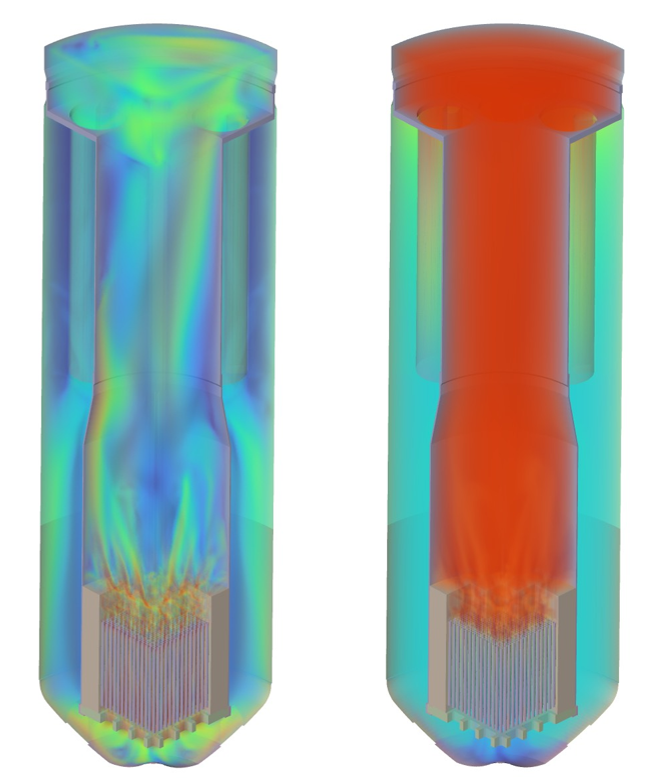
Heat transfer is a fundamental phenomenon in energy and process industry production processes. Using flow simulation, various forms of heat transfer – such as conduction, natural or forced convection, and radiation – can be modeled.
Flow simulation helps optimize processes, improve performance, reduce energy consumption, and ensure safe operation while considering environmental aspects. In process development, the goal is not only energy efficiency but also reducing resource requirements, increasing productivity, and improving safety.
CFD simulation enables you to compare different design alternatives to find the best solution. Simulation allows efficient comparison of dozens of design options, which would not be possible without CFD modeling.
The challenge is often that processes or energy production facilities do not allow testing different conditions or solution alternatives without a demanding test laboratory environment. In our virtual test laboratory, we conduct challenging test simulations that would not be possible or safe to perform in a real environment.
Services and competencies
- Heat exchanger optimization
- Power plants
- Heating and cooling systems
- Process optimization
- Natural and forced convection analysis
- Radiation heat transfer modeling
Contact us

Do you want to know more?
Small nuclear power plants generating emission-free energy may soon heat Finnish homes – pilot plant will help demonstrate safety
Finnish startup company Steady Energy will test a small nuclear reactor test facility in Helsinki’s Salmisaari in the coming years.
40 years of computational fluid dynamics: FINFLO supports the Finnish Air Force and European Space Agency
The FINFLO software is designed to simulate flows around aircraft, space probes and ships. Originating in the 1990s, the software remains relevant today, enabling advanced compressible flow calculations and simulations of dynamically changing flow environments.
Finding the full potential of CFD
CFD, or Computational Fluid Dynamics, is a method that is often utilized only for the post-design phase, although it is very well suited for wider and efficient use throughout the design process. Optimal use of CFD analysis generally shortens projects’ lead times and improves product assessment. It also provides an excellent basis for preparing digital twins. In process modeling tasks, CFD is an excellent tool for studying the components, for example.
Not only colorful pictures – CFD saves time and money
Did you know that by using computational fluid dynamics (CFD) you can save as much as 80 % in design time and 60 % in design costs? During the past 20 years, I’ve been lucky enough to participate in many interesting simulation projects both in Finland and abroad and have seen how clients have received instant help. But what is CFD really? Where can it be applied and why should it be utilized?