
Connections and Joints
Reliable connections are fundamental to structural integrity. We deliver comprehensive joint evaluation and analysis for the most demanding applications.
Joint strength evaluation is essential for ensuring overall structural performance. Our expertise spans a broad spectrum of connection types – from traditional bolted and welded joints to riveted and adhesive bonds. We have both manual calculation experience and state-of-the-art simulation tools to deliver optimal solutions.
Weld quality directly impacts fatigue life. We help you meet the requirements of classification society and international standards to ensure optimal weld quality. Our composite materials expertise extends to adhesive joint design, repair strategies, and both computational and practical implementation.
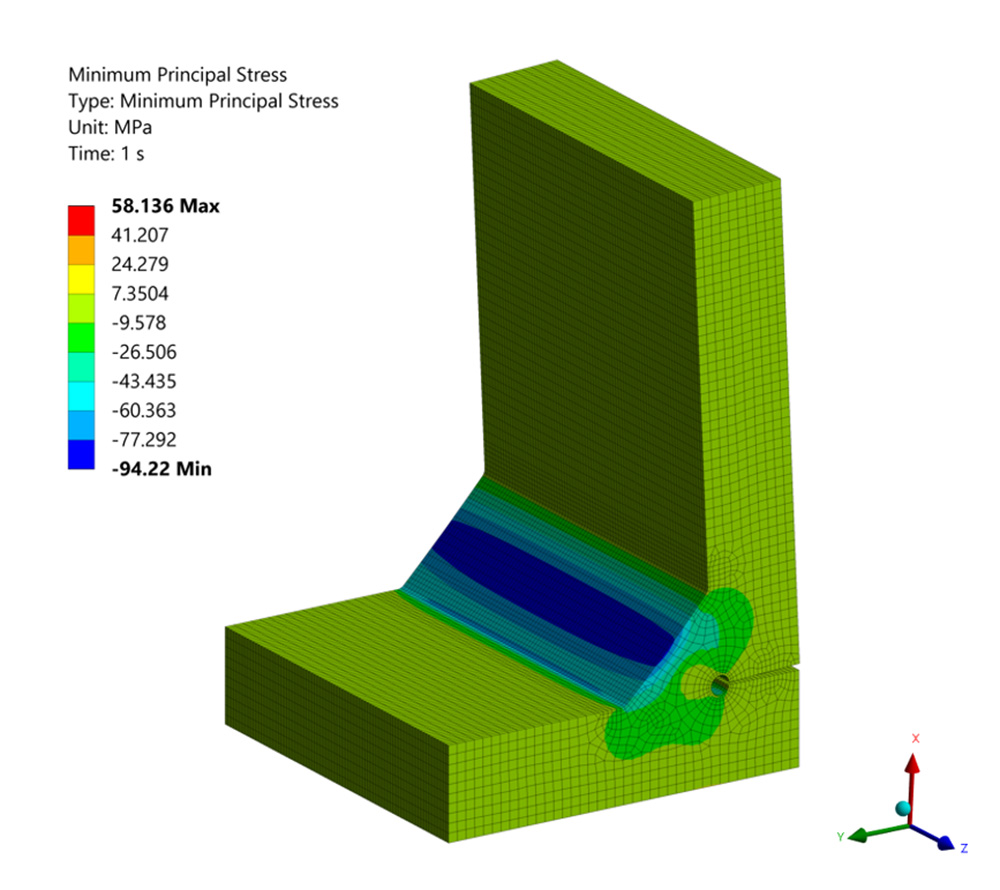
Accurate joint modeling ensures realistic force and stress distribution in simulations. For complex structures, our deep analytical expertise is essential for achieving functional, durable solutions that perform as designed.
Standards Compliance
- IIW (International Institute of Welding)
- EN (European Standards)
- VDI Guidelines
- DNV-GL Rules
Services and expertise
- Bolted connections
- Welded joints
- Riveted connections
- Adhesive bonds
- Hybrid connection systems
- Conformity
- Tolerances, fittings and contact pressures
Contact us

Do you want to know more?
Finding the full potential of CFD
CFD, or Computational Fluid Dynamics, is a method that is often utilized only for the post-design phase, although it is very well suited for wider and efficient use throughout the design process. Optimal use of CFD analysis generally shortens projects’ lead times and improves product assessment. It also provides an excellent basis for preparing digital twins. In process modeling tasks, CFD is an excellent tool for studying the components, for example.
Not only colorful pictures – CFD saves time and money
Did you know that by using computational fluid dynamics (CFD) you can save as much as 80 % in design time and 60 % in design costs? During the past 20 years, I’ve been lucky enough to participate in many interesting simulation projects both in Finland and abroad and have seen how clients have received instant help. But what is CFD really? Where can it be applied and why should it be utilized?