
Air ventilation
CFD analysis ensures ventilation functionality during design phase – from fire scenarios to cleanroom environments.
Flow simulation for ventilation systems can ensure adequate air exchange and proper conditions in various spaces. Simulations are used to model specific scenarios such as smoke extraction during fire events, ventilation in large industrial facilities, as well as continuous conditions in cleanrooms, for example.
Flow simulation can guide design work and validate design functionality at an early stage. CFD simulation ensures that space conditions meet desired requirements before construction or physical testing (such as smoke tests). When properly applied, flow simulation reduces design costs, improves design outcomes, and mitigates risks.
Our extensive experience in flow simulation, combined with our knowledge of the pharmaceutical industry, makes us a reliable partner in cleanroom solution design.
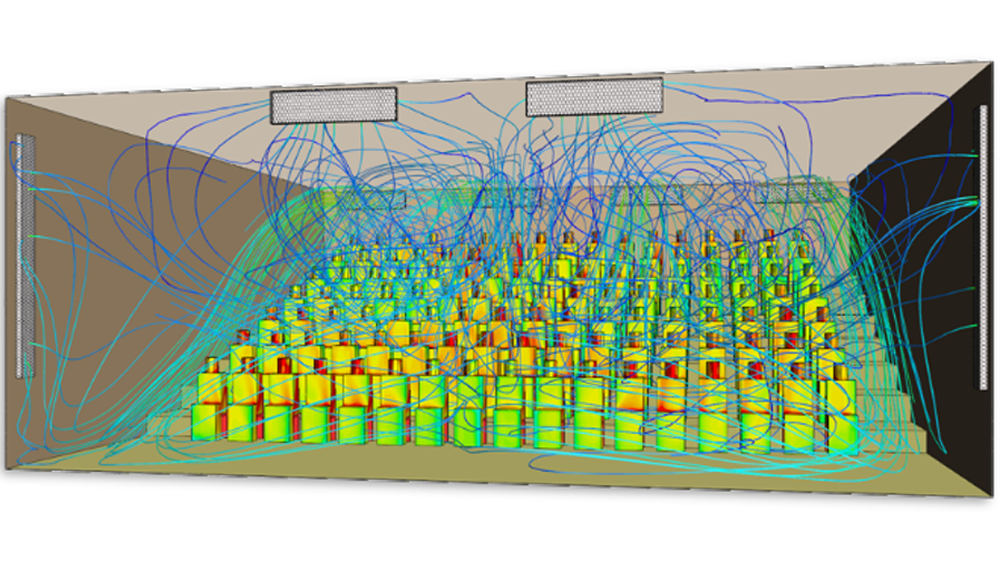
CFD simulations ensure a uniform and well-controlled airflow throughout the space, ensuring comfortable thermal conditions at every seating position.
Services and Competencies
- Cleanroom design and validation
- HVAC system optimization
- Ventilation system design
- Clean air distribution
- Environmental control systems
- Performance verification
Contact us

Do you want to know more?
Visualizing the invisible: How Elomatic uses CFD to perfect cleanroom design
Pharmaceutical manufacturing starts in the cleanroom, where strict control ensures safety and quality. It’s a finely tuned environment where science, safety, and precision engineering converge. A well-functioning cleanroom protects patients, ensures product quality, and safeguards operators. And when it comes to cleanroom design, even the smallest detail can have a significant impact. A slight imbalance in airflow can lead to contamination; a poorly positioned vent can cause turbulence that disrupts sterile conditions.
Ventilation simulation
CFD has been widely used in HVAC design to ensure optimum health and comfort for occupants in buildings and to meet regulatory requirements. In a HVAC CFD analysis, thermal comfort and air quality indicators such as temperature, relative humidity, pollutant concentration, velocity, and mean age of air, can be investigated.
Finding the full potential of CFD
CFD, or Computational Fluid Dynamics, is a method that is often utilized only for the post-design phase, although it is very well suited for wider and efficient use throughout the design process. Optimal use of CFD analysis generally shortens projects’ lead times and improves product assessment. It also provides an excellent basis for preparing digital twins. In process modeling tasks, CFD is an excellent tool for studying the components, for example.
Not only colorful pictures – CFD saves time and money
Did you know that by using computational fluid dynamics (CFD) you can save as much as 80 % in design time and 60 % in design costs? During the past 20 years, I’ve been lucky enough to participate in many interesting simulation projects both in Finland and abroad and have seen how clients have received instant help. But what is CFD really? Where can it be applied and why should it be utilized?